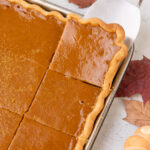
Pumpkin Slab Pie
Servings: 24 servings
Calories: 293cal
Equipment
- Hand mixer or stand mixer
Ingredients
- 14.1 ounce refrigerated pie crust
- 4 large eggs divided
- 30 ounces pure pumpkin two 15 ounce cans such as Libby's
- 1 ¾ cups light brown sugar packed
- 2 Tablespoons cornstarch
- 2 teaspoons pumpkin pie spice
- ½ teaspoon salt
- 2 ½ cups evaporated milk
- 1 Tablespoon Bourbon or amber-colored rum
- 1 teaspoon pure vanilla extract
- 1 Tablespoon water
Whipped Cream Garnish
- 2 cups heavy whipping cream divided
- 2 Tablespoons cream cheese at room temperature
- 1 cup powdered sugar
Instructions
- Remove the pie crusts from their packaging and place them on a lightly floured (or parchment-lined) surface. Overlap the two pie crust circles in the center by about 1 inch.
- Trim one inch from the outer two sides of each circle and place the scraps in the empty spaces at the top and bottom.
- Roll out the dough to a rectangle 3 inches larger than your jelly roll pan (in width and height). Trim the edges straight. Set any scraps aside for later use.
- Carefully drape the dough over the rolling pin and transfer it to a lightly greased jelly roll pan. Let the dough sink into the pan and gently guide it into the corners (the dough will be thin, so take care when doing this). Use any leftover scraps to fill in holes.
- Fold the dough hanging over the edges, in on itself (this will provide the support for making your fluted edging). Using your thumb and two index fingers, pinch along the outer edges of the dough to form a scalloped or fluted pattern. Prick the bottom of the dough with a fork.
- Place the jelly roll pan in the refrigerator to chill for at least 2 hours (or, better, overnight).TIP - After shaping, the dough will be warm, so it’s important to refrigerate it for a minimum of 2 hours (but best overnight) before blind baking. You can also speed up the chilling process by freezing the dough.
Preparing the Filling and Assembling
- Preheat the oven to 425°F. While it preheats, place a baking sheet larger than your jelly roll pan in the oven.TIP - To achieve an evenly baked pie crust, I like to place a baking sheet (larger than my jelly roll pan) in the oven during preheating. As the oven heats up, so does the metal, creating even heat distribution, which allows my pie crust to cook from the bottom.
- Separate the yolk from the white of one egg and set them both aside.
- While the oven is preheating, make the filling by whisking the pumpkin, brown sugar, 3 eggs, egg yolk, cornstarch, pumpkin pie spice, and salt.
- Once combined, add the evaporated milk, bourbon or rum (if using), and vanilla extract. Whisk to combine.
- Lay a sheet of parchment paper over the base of the pie dough and place pie weights on top.
- Par-bake the crust by blind baking it for 10-15 minutes. Place the jelly roll pan on a wire rack to cool and remove the parchment paper and pie weights. Reduce the oven temperature to 350°F.
- Whisk the egg white and water together and lightly brush the mixture on the edges of the dough.
- Pour the filling evenly onto the crust.
- Place the pie back in the oven on the preheated baking sheet and bake for approximately 40 minutes or until the filling is slightly jiggly in the center. Remove the pan from the oven, set it on a wire rack, and allow it to cool completely.TIP - The pie is done when the filling still has a slight jiggle but is not wobbly. If yours is wobbly, return it to the oven and bake for additional 5-minute increments.
How to Make the Whipped Cream
- Combine ½ cup of the heavy cream and the cream cheese with a handheld mixer (or stand-up mixer with the whisk attachment), and mix until smooth. Add the powdered sugar and remaining heavy cream. Increase the speed and mix until soft peaks form.
- Top the slices of pumpkin pie with the whipped cream and serve.
Notes
- Depending on the dimensions (depth) of your jelly roll pan, you may have extra filling. Don’t overfill the pie; only pour as much filling into your pie crust so it rests just below the level of the edges. The filling will puff up during baking, and you don’t want the filling leaking over the edges.
- Not all canned pure pumpkin is equal. Stick with Libby’s brand, as it is thick. Many other brands contain more liquid which can make for a runny pie filling.
- The fluted edges will tend to ‘relax’ during par-baking. It’s important to properly chill the dough and only par-bake when the oven is at its optimal temperature to keep as much of the fluted shape as possible. An oven thermometer is the best indicator of your oven's actual temperature.
Nutrition
Serving: 1slice | Calories: 293cal | Carbohydrates: 36g | Protein: 5g | Fat: 15g | Saturated Fat: 8g | Polyunsaturated Fat: 1g | Monounsaturated Fat: 5g | Trans Fat: 0.003g | Cholesterol: 62mg | Sodium: 172mg | Potassium: 223mg | Fiber: 1g | Sugar: 25g | Vitamin A: 5931IU | Vitamin C: 2mg | Calcium: 114mg | Iron: 1mg
